
Children’s health

Treating children while the line is still being drawn.

Classical homeopathy for children with recurrent infections, asthma, eczema, fears and nightmares, bedwetting, temper and behavior, ADHD and the autism spectrum, in San Diego and online worldwide.

Why I give this work priority

A small change early becomes a large one later.

Every chronic illness I see in an adult has a history that began long before the diagnosis. Hahnemann traced that history to the miasm: an inherited susceptibility, carried down a family line, that shapes which illnesses a person is prone to and how they express them.

In an adult, that susceptibility has had thirty or forty years to settle in. It has been through infections, suppressions, stresses and treatments, and by the time I meet it, some of it has become structural.

A child is different. Development is still a line being drawn, and the susceptibility is still largely functional: close to the surface, quick to show itself, quick to respond.

Change the slope of a line slightly at its start, and ten years later it ends somewhere entirely different.
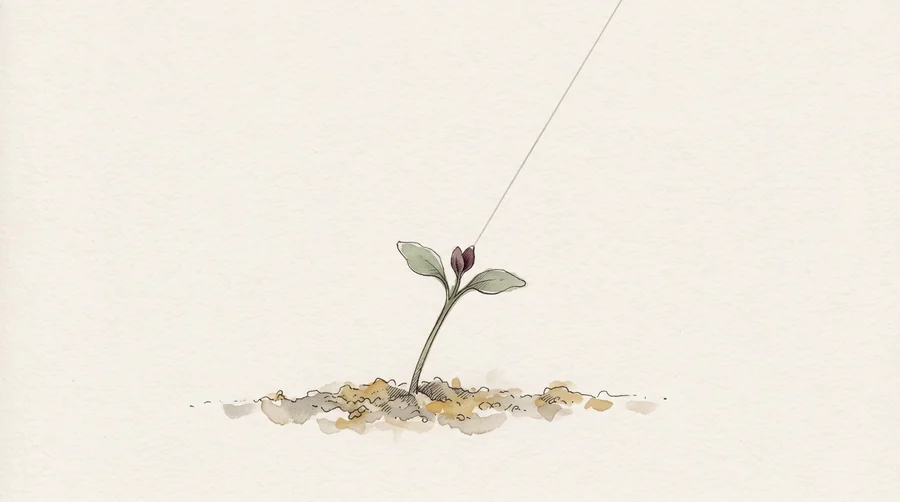
Watercolor of a young seedling leaning slightly from the soil, with a faint pencil line extending its angle upward
The angle at the soil decides where the plant stands years later.

That is why I regard deep, anti-miasmatic treatment of children as the most consequential work in my practice. The aim is not only to clear this winter’s chest infection or this month’s rash. It is to address the susceptibility that keeps producing them, at the age when that susceptibility is most open to change.

How I take a child’s case

The family history is often the case.

When a child has a fourth ear infection in a year, the infection is what everyone is looking at. I am looking at what made this child the one who gets them, when a sibling in the same house, at the same school, catching the same colds, often does not.

So I ask about parents and grandparents: the asthma, the eczema, the thyroid, the arthritis, the depression, the illnesses a family tends not to talk about. I ask about the pregnancy and the birth, about early milestones, and about what the child is like when well, not only when ill. What frightens them, how they sleep, what they crave, how they are with heat and cold, how they take being told no.

Children are good patients in this respect. They do not edit their symptoms or explain them away. A two-year-old cannot describe a remedy picture, but will display one completely, and a parent who has watched closely is the most accurate observer I could ask for. This is also why online consultations work well for children: much of what I need comes from a parent’s observation and from seeing the child as they are at home.

What parents arrive with

Two children with the same diagnosis rarely need the same remedy.

As with adults, the remedy is chosen from the child, not from the diagnosis. Two children with the same asthma and the same inhaler can need entirely different remedies, because the illness is expressing itself through two different temperaments and two different family lines.

Still, parents reasonably want to know whether their situation is familiar ground. In most weeks I am working with children who have:

Recurrent respiratory infections Ear, throat and chest infections; the cold that becomes bronchitis every winter
Asthma and wheezing Alongside the child’s inhaler and asthma plan
Eczema and skin conditions Eczema, allergic skin, hives and recurring rashes
Fears, phobias and nightmares Night terrors, fear of the dark, separation anxiety
Bedwetting Including children who were dry and began again
Temper and behavior Tantrums, defiance, intensity out of proportion to the trigger
Attention and focus Children with an ADHD diagnosis, or where one is being considered
Autism spectrum Supporting the whole child: sleep, anxiety, digestion, sensory overwhelm

Many children arrive with several of these at once. A chest that is always congested, a rash and a short temper are often one picture rather than three problems. If yours is not listed, write and ask.

From parents

Families tend to stay for years.

For the past 10 years I have been emailing or calling him frantically when my kids get sick, and every single time, after carefully evaluating the case, whether chronic or acute, he comes up with the remedy.

Natasha K.

My child, extended family members, and I have been under his care for more than three years.

Srinithya Karthik
What to expect

Two to three years, and the first changes are rarely the ones you are watching.

There are two timelines in a child’s case, and it helps to keep them separate.

The first is the complaint that brought you. Children generally respond faster than adults, and the presenting problem often begins to move sooner than it would in a grown-up with the same history.

The second is the deeper work: treating the inherited susceptibility underneath. That takes two to three years of steady, unhurried prescribing, with follow-ups spaced to the child’s response. It is the part of the work I care most about, and the part most often abandoned too early, once the original complaint has settled.

The first changes usually appear somewhere other than where you are watching. Sleep, appetite, temper and energy tend to shift before the named problem does. The signs I look for are quiet ones: an infection that would once have gone to the chest and stays a cold; a recovery measured in days rather than weeks. In classical terms this follows Hering’s observation that improvement moves from the inside outward and in reverse order of appearance, which is also why an old rash sometimes returns briefly as a chest improves. We talk about that before it happens, so that it is not alarming when it does.

Over the longer course, what parents most often describe is resilience: fewer illnesses and quicker recovery, more vitality, a calmer and more grounded child, better attention and stamina.

These are observations from practice, not a guarantee for any particular child. But they are the reason I ask families to think in years rather than weeks.

Alongside your child’s medical care

Your pediatrician stays your pediatrician.

Keep your child’s pediatrician, and keep the checkups. If your child has asthma, the inhaler and the asthma action plan stay exactly as prescribed, and a child who is struggling to breathe needs urgent medical care, not a remedy and a wait. If your child takes medication for ADHD or anything else, changes to it belong to the doctor who prescribed it. Occupational, speech and behavioral therapies continue as they are.

I am a certified classical homeopath. I am not a physician. What I do see, often, is that as a child’s overall health improves, it is their own doctor who begins to reduce what they need. That is the correct order, and the only one I work in.

Further reading

For parents who want to read further.

Several shorter pieces cover parts of this ground in more detail: homeopathy and ADHD, homeopathy and allergies, managing fevers, and a classical perspective on immunity.

For a general introduction, The Invisible Cure is a documentary on classical homeopathy that follows several patients through their treatment.

Ready to begin?

The first step is a detailed initial consultation.

A child’s case needs a full family history and an unhurried conversation with the parents. Consultations are in person in San Diego or online anywhere in the world.